

Why Oxidized Bitumen 95/25 Exists
Not every project needs flexibility.
Some systems fail not because they crack but because they move.
Oxidized Bitumen 95/25 is engineered for situations where uncontrolled flow, thermal deformation, and long-term instability become structural risks. This grade is designed to limit movement, maintain form, and protect surfaces under continuous exposure to heat, moisture, and chemicals.
Functional Role in Infrastructure & Industry
Oxidized Bitumen 95/25 is not selected based on softness or ease of application.
It is chosen when the material must act as a protective layer, not a dynamic one.
Typical functional roles include:
Acting as a rigid waterproof barrier
Providing corrosion protection where coatings must not migrate
Stabilizing interfaces in hydraulic and public works structures
Serving as a durable binder in mastics and caulking systems
Forming a stable coating base for asphalt based industrial paints
Protecting pipe surfaces exposed to moisture and chemicals
Serving as a structural base layer in synthetic turf systems
In these applications, dimensional stability is more important than flexibility.
Material Behavior Under Heat
Oxidized Bitumen 95/25 remains solid at ambient temperature and requires controlled heating to reach workable viscosity.
Flow is achieved at approximately two times the softening point
Typical handling temperatures range from 140°C to over 200°C
For highly oxidized conditions, temperatures up to 230°C may be applied under inert atmosphere
When handled correctly, the material can be reheated or held at elevated temperatures without losing performance.
However, excessive heat combined with oxygen exposure accelerates unwanted oxidation and may reduce long-term durability.
Surface Interaction Logic
Oxidized Bitumen 95/25 relies on mechanical and chemical bonding, not penetration into contaminated surfaces.
For effective performance, substrates must be:
Dry and free from moisture
Clean, without dust or loose particles
Free from curing agents, slurry, or formwork residues
Structurally sound and uniform
Poor surface preparation leads to failure — regardless of material quality.
Inside the Blowing Process (95/25)
The air-blowing process is a chemical conversion, not simple aging.
During production, hot bitumen is exposed to controlled oxygen flow, triggering:
Oxidation
Dehydrogenation
Polymerization
Oxygen uptake results in the formation of hydroxyl, carbonyl, acid, and ester groups. Analytical studies confirm that the absorbed oxygen is fully accounted for by these groups, with no ether oxygen detected.
This controlled chemical restructuring increases softening point, reduces penetration, and improves resistance to heat and aging.
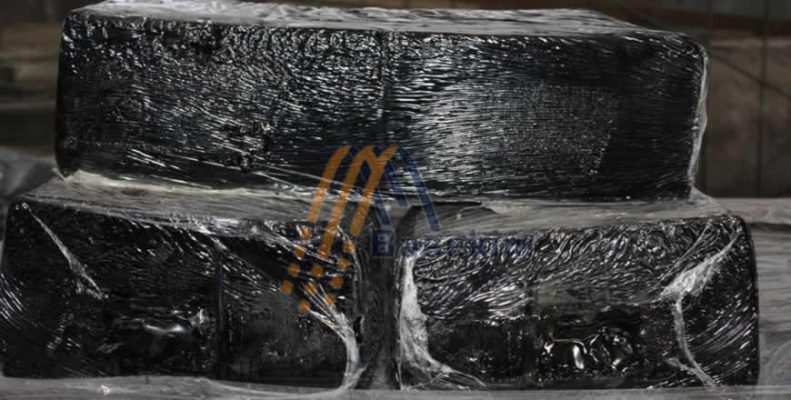
Where 95/25 Fits Best
Oxidized Bitumen 95/25 sits in a performance zone where:
Movement is a liability
Shape retention is critical
Thermal stability defines service life
Long-term protection outweighs ease of processing
It is a control-grade material, not a compromise grade.


